Part 5: Influence and information campaigns: from Twitter to Telegram

Header IS Briefing Part 2

The theology of al-Qa’ida (AQ) and subsequently of the “Islamic State” (IS) and its ability to propagate that theology as a monopoly of truth through professional promotion and marketing material disseminated via modern communication technology has proven to be its most resilient foundation and greatest innovation. This Jihadist media activism is evident and strengthens this resilience on a daily basis with new audio-visual and written propaganda uploaded from a number of conflict zones, in numerous languages, to a wide range of online social platforms and multimedia channels.

In the West, policy makers are struggling to cope with the massive quantity and often times high quality productions issued by groups such IS who continue to draw in new recruits from western societies each month. Although slowly recognized by policy-makers that the so-called “counter narratives” are failing, as outlined in a New York Times article 2015.[1] IS has proven it’s resilience on the battlefield and the West has so far employed half-hearted “counter-narratives”, that usually neither touch on the Arabic propaganda content nor the messages conveyed by non-Arab foreign fighters who explain their reasons for joining the cause in their own words. Due to the tactical focus of both “counter-narratives” and takedowns, the U.S. and its Western allies are being drawn into open warfare online, on a battlefield chosen by their jihadist adversaries. And it is those jihadists who will thrive in the chaos that results. As outlined with Ali Fisher in the article “ISIS is Winning the Online Jihad Against the West” for The Daily Beast in October 2014 , the ideology/theology of IS, offering a coherent worldview while gaining and consolidating territory, has proven time and again to be resilient on all layers on the Internet.[2]

As of 2017, with the partial loss of territory and the de-population of Sunni urban centers in Syria and Iraq as a consequence, IS has withdrawn to the countryside, to continue the fight – and to maintain and upkeep their greatest weapon: media work as means of long-term influence and resistance.

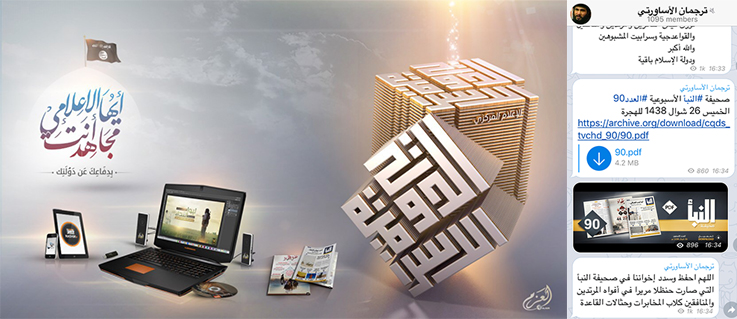
From 2011 onwards, the main layer for Sunni jihadists online was Twitter, in addition to Facebook and YouTube, especially since the outbreak of violence in Syria. This propagation effort by the so-called “media mujahidin” has been approved and sanctioned by lmovement leaders, and now contributes to the interconnected jihadist zeitgeist.[3] For example, jihadist groups had been using Twitter to disseminate links to video content shot on the battlefield in Syria and posted for mass consumption on YouTube.[4] Since 2011, members of jihadist forums have issued media strategies that encourage the development of media mujahidin. This encouragement has been accompanied by the release of guides to using social media platforms, which often included lists of recommended accounts to follow.[5] With relatively little effort, IS was able to maintain massive networks on Twitter. This gave the media operations a whole new and unprecedented situation: releasing videos from within what is defined as “Islamic territory”, liberated from their enemies to a massive number of active or passive followers.[6]

Twitter did an excellent job in preventing IS from upkeeping their massive networks, despite the commitment and dedication of some of the media mujahidin to re-open in some cases hundreds of new accounts. This changed when Twitter became more effective at banning IS content by adjusting their spam settings, severely weakening the jihadist’ network on their platform. The degradation of IS networks on Twitter led many Western observers on Twitter to believe IS in general is in decline. However, while the ‘Twitter ship’ was sinking for IS, the online swarm simply turned to a new social media platform.

Early 2016 we witnessed a massive shift from Twitter to Telegram among IS militants and sympathizers. Until then IS was able to maintain a persistent network on Twitter, despite a massive rate of account suspensions. Because media mujahidin are highly dedicated – as much as they are on the battlefield – IS Twitter users usually reappeared on the platform using a different account – once they had been banned. From a user perspective, all you needed to be aware of was a good set of Arabic and non-Arabic key words to find IS content on Twitter, and then start following the  accounts. At the same time, the IS network on Twitter was not taken down at once, and the remaining accounts keenly promoted the new Twitter handles of those who came back.

With the massive move to Telegram, where IS now has settled in full, Twitter is used as a secondary platform to post specific – not all – content. On Telegram IS users and sympathizers are among themselves and in order to initiate new members, these have to undergo a process of vetting or simply have to know the Arabic theology after being invited to a couple channels to manually get into the deeper networks.

The community has migrated from Twitter to Telegram, yet Twitter is used by the community to stage “media raids” from Telegram. This is not about community building, rather it is about posting current event driven content on Twitter and by the time these temporary accounts are either taken down or obsolete otherwise, IS has new event driven content that is then pushed into Twitter and elsewhere from the IS core on Telegram.

[1] Mark Mazzetti and Michael R. Gordon, ISIS is Winning the Social Media War, U.S. Concludes, The New York Times, June 13, 2015, http://www.nytimes.com/2015/06/13/world/middleeast/isis-is-winning-message-war-us-concludes.html?_r=0

[2] Ali Fisher and Nico Prucha, ISIS is Winning the Online Jihad Against the West, The Daily Beast, October 1, 2014, http://www.thedailybeast.com/articles/2014/10/01/isis-is-winning-the-online-jihad-against-the-west.html

[3] Al-Manhajiyya fi tahsil al-khibra al-i’lamiyya, Mu’assasat al-Furqan & Markaz al-Yaqin, part 1,” Markaz al-Yaqin and al-Furqan, May 2011. Two jihadist media departments from Iraq published this Arabic language handbook, part of a greater series. Jihadist activity is sanctioned through the existing core fatwa (authoritative religious ruling or decrees) based on historical scholars such as Ibn Taymiyya (1263-1328), the famous Hanbali scholar, and enriched by the senior leadership of al-Qaida and now ISIS. Thus, any local jihadist, al-Qaida- or ISIS-affiliated action can fall under this umbrella approbation, thus increasing its appeal. See Prem Mahadevan, “The Glocalisation of al-Qaedaism,” Center for Security Studies, 22 March 2013.

[4] Ali Fisher and Nico Prucha, “Tweeting for the Caliphate: Twitter as the New Frontier for Jihadist Propaganda”, CTC Sentinel, June 2013, West Point.

[5] Discussed in Ali Fisher and Nico Prucha, “Jihadi Twitter Activism – Introduction”; Nico Prucha, “Online Territories of Terror – Utilizing the Internet for Jihadist Endeavors,” Orient 4 (2011). Members of the Ansar al-Mujahidin forum and Shumukh al-Islam have posted advice encouraging fellow users to develop social media profiles to disseminate their message to a wider group of users. See, for example: “The Twitter Guide: the Most Important Jihadi Users and Support Accounts for Jihad and the Mujahideen on Twitter:” http://www.shamikh1.info/vb/showthread.php?t=192509

[6] For a discussion on the themes of content and networks, including visualized Twitter IS networks:

Ali Fisher, Nico Prucha, Turning up the volume to 11 is not enough: Why counter-strategies have to target extremist clusters, Jihadica, February 9, 2015,

http://www.jihadica.com/turning-the-volume-up-to-11-is-not-enough-why-counter-strategies-have-to-target-extremist-clusters/

Ali Fisher, Nico Prucha, Turning up the volume to 11 is not enough: Networks of influence and ideological coherence, Jihadica, and March 23 2015,

http://www.jihadica.com/turning-the-volume-up-to-11-is-not-enough-part-2-networks-of-influence-and-ideological-coherence/

Part 4: Understanding the Resilience and Appeal of “Islamic State” Electronic Propaganda and Beyond

Resuming the ” Islamic state Briefing”, this week with part four. The depth of the jihadist movement ranges back to the 1980s and ISIS has its history since the 2000s.

The study of the Jihadist movement has tried to understand it in terms of street criminals, gangsters, individuals obsessed with computer games (particularly first person shooters), and a desire to go from zero-to-hero. It hardly addresses foreign fighters from Arab countries and often lack any attempt to address the theological aspects of the movement, imagery, encoded messages and prominence of scholars within the Jihadist movement’s overall interpretation of theological concepts, including an Islamic State model of governance. Reducing the Sunni extremist cosmos by only focusing on the “Islamic State” after 2013 at best, referring to them as “jihadists” while not even considering the history of IS since the very beginning in the 2000s, leads to a marginal understanding of the group and the motivations behind it. Neglecting the massive quantity of high quality Arabic language writings by ISIS and the Sunni extremist cosmos it stems from is a disaster. Core concepts such as tawhid or shirk are widely unknown and only briefly explained at best. What is missing is a discourse based on thorough, evidence based facts. However, these facts cannot weigh into discourse or echo within academic research, when Arabic sources and the theological universe that drives Sunni extremists remain neglected. Without proper Arabic skills and with no deep-rooted research on Islamic theology, the Sunni extremist movements remains hidden behind a firewall. Without knowing this content by heart and being able to decipher visual codes, uncovering extremist networks online is a challenge and has led to the assumption there is a decline of ISIS media production. This is the case, if researchers only look at superficial English language content on Twitter and do not see the rich blend of materials that are published in Arabic – and since early 2016 to a great extent on Telegram.

Ignoring the huge library of writing by focusing on only the narrow daily announcements, or English language material, leads to dangerous misinterpretations of the movement – even more so, when not even Latinized Arabic key words in English language propaganda releases are questioned or taken into consideration. Facing the contemporary challenge of the Jihadist movement, policy cannot afford to fall for superficial interpretations, which emphasize memes, general simplifications, infographics, and flashy videos – and generally ignore the deep theological nuanced Arabic publications.

The movement is significantly more complex than these interpretations suggest.

The ideology that is based on theological concepts and framings of al-Qa’ida (AQ) and subsequently the splinter group the Islamic State (ISIS) and its ability to propagate this theological spectrum as a monopoly of truth through professional promotion and marketing material disseminated via modern communication technology has proven to be its most resilient foundation and greatest innovation. This Jihadist media activism is evident and strengthens this resilience on a daily basis with new audio-visual and written propaganda uploaded from a number of conflict zones, in numerous languages, to a wide range of online social platforms and multimedia channels.

Policy makers in the U.S. and the E.U. lack a thorough understanding – for jihadist narratives that are widely based on religious scripture, advocating a cohesive and coherent ideology, that is, to be precise, theology. This theology is based on complex religious principals, offered mainly in Arabic and has its basis in the 1980s to contemporary al-Qa’ida ideologues, whereas ISIS in particular displays the implementation thereof in oftentimes easy to comprehend audio-visual productions. The Sunni extremist writings and videos from back in the 1980s to today refer and cite not only religious scripture, selected ayyat from the Qur’an and hadith – deeds and sayings ascribed to Prophet Muhammad – but also cite and reference historical Sunni Islamic scholars such as Ibn Taymiyya, Muhammad ibn ‘Abd al-Wahhab, Ibn al-Qayyim or Ibn Nahhas, to name a few. This is part of the textual layer that is being pushed out on all channels on the Internet. Historical scholars – overwhelmingly having written in Arabic  – are often quoted “who says there is no distinction to be made between combatants and non-combatants. A Wahhabi scholar from the 19th/20th century is quoted saying that in principle killing unbelievers is allowed. This is another proof for the family resemblance between Wahhabism and Jihadism, easily substantiated by the number of theological tracts republished by IS”, as noted by Rüdiger Lohlker in reference to the Barcelona attacks. Without Arabic and the proper command of knowing who such historical scholars are and under which circumstances their theological treatises were penned and why this matters today and  how this is used by online media savvy activists, most documents and videos by jihadists remain a safe haven. Not to mention the general lack of understanding the scope, pace and depth ISIS has on Telegram, whereas most studies of 2017 solely focus on Twitter, claiming twitter remains the entry point and primary dissemination hub for ISIS.

Community building takes place on Telegram and twitter is used for media raids – while the content varies between Arabic theological support materials and core graphic materials. Researchers need to focus on both while understanding and the ecosystem and where it all stems from.

The daily content is just the tip of the iceberg. The archive of Sunni extremism represents what the movement is about, lays out the strategy, and justification for actions. Alone ISIS released over 2,000 official videos and much more daily short clips; all in all, from the 1980s to today, over half a million – mainly Arabic – documents exist in digital format, whereas materials before the age of mass digitalization have been digitalized by the first generation of committed electronic media mujahidin in the 2000s.[1] 116 editions of the Arabic language magazine “al-Jihad” were printed and disseminated from 1984-1995, focusing on Afghanistan, Palestine and later the Balkans. The first generation of al-Qa’ida on the Arab Peninsula (AQAP) pioneered the electronic frontier of jihad by releasing two magazines, “The Voice of Jihad” (in sum over 1,500 pages) and “The Military Camp of the Sword.” Nothing about ISIS as of 2017 is new, if such magazines have been read and taken into account when studying jihadism.
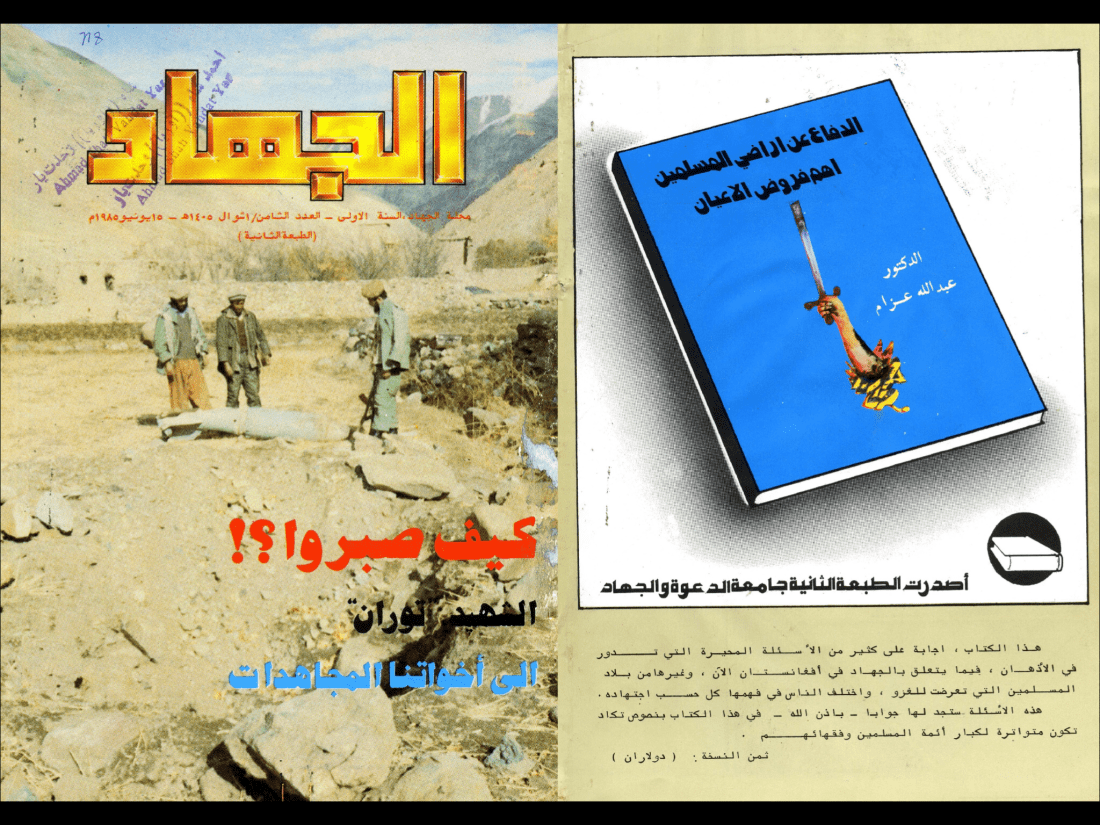
The cover of the al-Jihad magazine of June 1985 addresses “our sisters, the Mujahidat”, women who fought alongside males in the war against the Soviet occupation. More telling, however, is the advertisement for ‘Abdallah ‘Azzam’s book “The Defense of Muslim Lands is the Among the Most Important of an Individual’s Duties”. ‘Abdallah ‘Azzam was a Islamic scholar (shaykh) from Palestine and had been a university lecturer for Islamic jurisprudence (fiqh) in Amman, Jordan.[2] In 1989, he and his two eldest sons Muhammad and Ibrahim were killed in a car bomb in Peshawar, Pakistan.[3] ‘Azzam is until now, decades after he died, one of the most influential theologians, who is being regularly cited, referenced and eulogized by all outlets of jihadist media capacity.[4] In 1988, ‘Azzam travelled to Seattle, USA, and gave a khutba, the Friday prayer. This khutba was filmed and that video is part of the Sunni extremist ecosystem. While he was in Seattle, the conflict in Afghanistan was slowly but surely coming to an end. Dominated by the events of the jihad against the Soviet Red Army, ‘Azzam not only tries to recruit and ‘re-introduce’ Islam to his audience of America-based Muslims but he moves a step ahead and attacks the United States as another major, logical future enemy at a second or third stage of jihad with the victory in Afghanistan in sight for the Mujahideen. ‘Azzam’s khutba provides a usual mix of citations from the Qur’an and sunna, bound to his contemporary tales of the fighting Mujahidin as well as the suffering Muslim population in Afghanistan. While he also includes stories and details of individual Mujahidin who fought and died, who attained the “shahada on the path of God” (i.e. died as ‘martyrs’) and witnessed divine blessings during their service for God, ‘Azzam repeatedly addresses the need to “establish an Islamic state” that can only be realized by jihad, combat (qital) with the potential to enter Paradise (janna) while struggling for this divine aim. ‘Azzam, who was a highly industrious writer and who frequently gave sermons, introduced stories from the Afghan jihad and tales of the shuhada’, killed Mujahideen who as a result attained the shahada for the sake of religion, and has made such stories from the frontlines of jihad popular, accessible and perhaps somewhat mainstream.[5] One of his documents, the 251 page long writing entitled “The Craving for the Women of Paradise” (al-hur)[6], can be considered as a template for contemporary jihadist publications (writings and videos) regarding the shuhada’, glorifying jihad and providing the theological and historical necessity to do so.
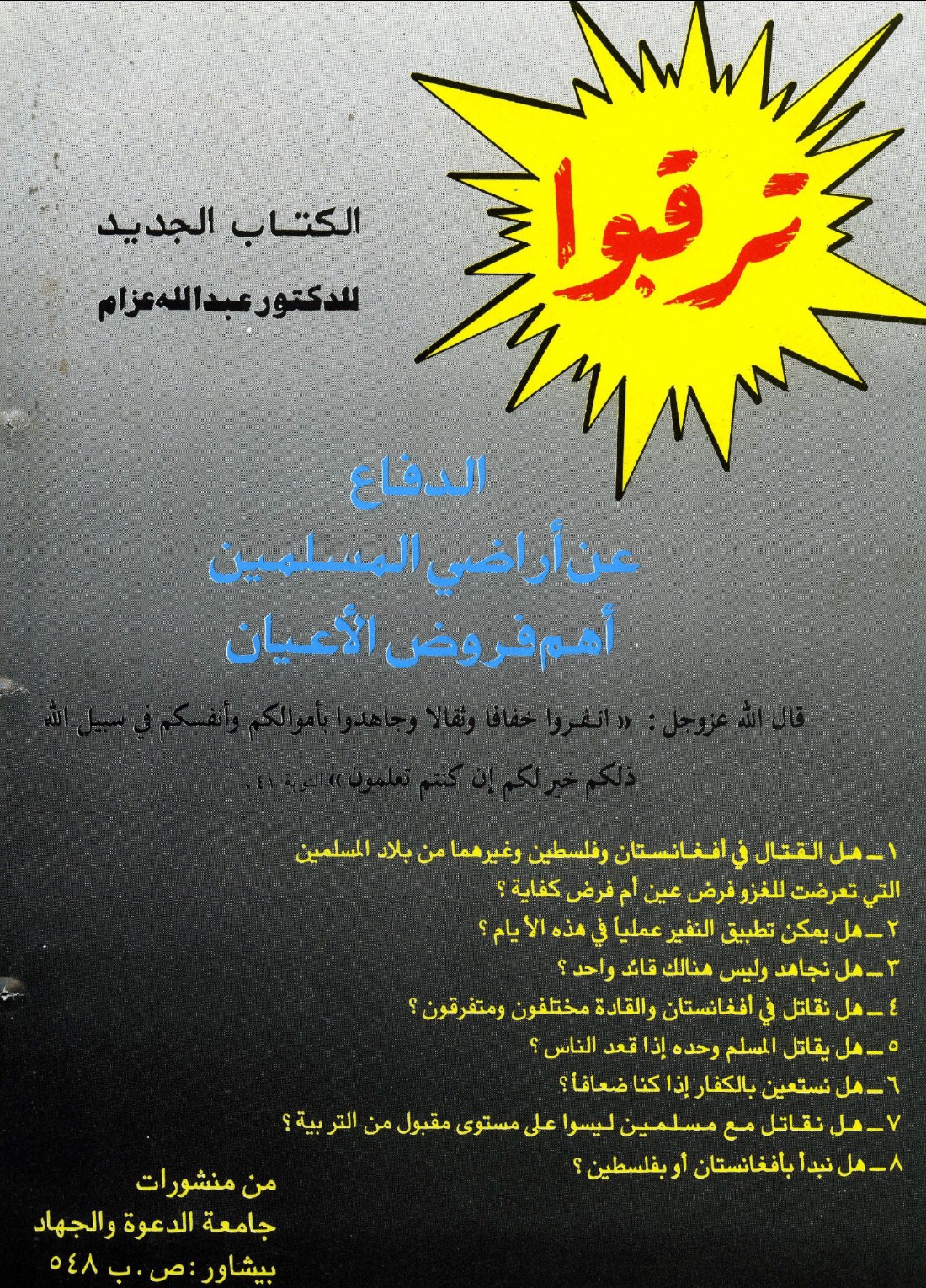
For jihadis, the age old question of fard al-‘ayn and fard al-kifayya, pondering whether or not combat is confined to Afghanistan and Palestine at this stage (mid 1980s);

Addressing the theological-operational element of nafir;

And the questions of Muslim unity and disbeliever aggression, etc. all of these elements matter for jihadism and since the Syrian revolution turned extremely bloody and was hijacked by seasoned jihadist fighters and clerics, these elements are of essential value to understand the mess in the Middle East (and attacks/operations elsewhere; besides Europe there are The Philippines, Indonesia, various attacks in Russia, Maldives etc.).

This is just one example of the tradition of Sunni extremist content – online &offline – that forms the basis of materials published by the “Islamic State” as of 2017. Including, materials that are available online and are also handed out within ISIS territories, as has been documented since 2013 by the very media cycle of ISIS.

This ecosystem contains the answers to questions posed by those who only read the daily updates. For example, the archive of the Jihadist movement contains the rationale stretching back to fighting with the Soviets in Afghanistan for when female suicide bombers are permitted and when they are not, it is no mystery when research takes in the archive of Arabic documents.

The documents and videos produced by Islamic State project what they consider to be a real Sunni Muslim, on the path of God who acts in accordance with divine rule and regulations which the early Muslims had under the leadership of Prophet Muhammad. Any release by IS – as much as by AQ – seeks to inform, educate and convince the consumer that the jihadis are the only “true” Muslims, following the correct “prophetic methodology” This ideational content echoes an earlier prediction about an internet-enabled ideological struggle over the definition of reality. In this vision, warfare would be “conducted on an entirely new battleground; it is a struggle not over territory or boundaries but over the very definitions of these terms”[7] where IS seeks to maintain hegemony over concepts such as the “prophetic methodology” and other theological concepts expressed by key words.

The battle for these definitions occur in the physical landscape and equally on the digital platforms that comprise the information ecosystem.

Neglecting the evidence that jihadi networks online are both agile and unified around coherent theological “narratives”, risks breeding a sense of complacency, which allows the Islamic State (and other jihadi groups) to develop physical and digital locations to which they can retreat and regroup. This is a real risk if the current shift in distribution strategy adopted by the Islamic State is viewed as decline, rather than a reconfiguration and refocusing of effort. Yet acknowledging that the “decline” is based on faulty research, which neither takes the vast amount of Telegram communication into consideration or Arabic language materials (or Arabic words used in non-Arabic propaganda releases).

Islamic State communicates its strategy to supporters predominantly in Arabic and oftentimes uses citations of legitimate mainly Arabic language scriptures, the Holy Qur’an and Hadith (deeds and sayings of Prophet Muhammad) as well as scholarly religious (historical and contemporary) writings.[8] These citations of historical as well as contemporary Islamic scholars are frequent in writings and are woven into the audio-visual productions of jihadis.[9] This cannon of material which jihadis  have to hand justifies, from their perspective, their acts and seeks to provide a clear identity; of what being a “Sunni Muslim” means to them.

[1] Nico Prucha: Die Stimme des Dschihad – al-Qa’idas erstes Online Magazin, Dr. Kovac: Hamburg, 2010.

[2] Hegghammer, T. (2008) Abdullah Azzam, der Iman des Dschihad in Kepel, G. / Milelli, J. (2008) Al-Qaida – Texte des Terrors (München, Zürich: Piper), pp. 148-157. Hegghammer describes ‘Azzam’s academic development, his “religious studies in Damascus (1963-1966)”, his “Palestinian Jihad (1967-1970)”, his “promotion at the al-Azhar” University, Cairo, (1971-1973) and his “years in Amman (1973-1980)”. He become a professor in Jidda and was able to acquire a position in the Saudi funded new international Islamic University in Islamabad.

[3] He was killed on Friday, 24.11.1989 at about seven o’clock in the morning, on his way to a mosque in Peshawar to preach the Friday sermon. Muhammad was 20 and his brother 15 years old (Hegghammer). Various conspiracy theories exist, who killed ‘Azzam (Hegghammer, pp. 163-164). Ranging from bin Laden who had him removed to gain control over the Arab fighters, to al-Zawahiri, who wanted the Egyptians in charge and who wanted to attack the regimes in the Middle East while ‘Azzam vowed for the Mujahideen to remain in Afghanistan to found a true Islamic state. Or was it a personal revenge, committed by an Afghan splinter group or was it the ISI?

[4] The double-agent Abu Dujana al-Khurasani, aka Humam Khalil Abu-Mulal al-Balawi, who on 30 December 2009 killed several CIA and Jordanian GID agents in Khost, Afghanistan, by undertaking a suicide-operation claimed in one of “last interviews” also to have revenged ‘Abdallah ‘Azzam. According to al-Balawi, the GID is responsible for his murder. Prucha, N. (2010) Notes on the Jihadists’ Motivation for Suicide-Operations, Journal for Intelligence, Propaganda and Security Studies, 4 (1), pp. 65.

[5] ‘Azzam, ‘A. (1987) Ilhaq bi-l-qafila, http://tawhed.ws/r?i=6nxrvref (25.10.2010). “Join the Caravan” is a classical work of the jihad literature.

[6] ‘Azzam, ‘A. ‘Ushshaq al-Hur, http://tawhed.ws/dl?i=pwtico4g (02.10.2010). “The ‘Abdallah ‘Azzam folder” can be accessed here: http://tawhed.ws/a?a=a82qriko.

[7] Douglas Rushkoff, Cyberia: Life in the Trenches of Hyperspace, Harpercollins Publishers (reprint): New York, 1995.

[8] Among the tens of thousands of writings are prominent items such as “An Abbreviated Biography of the Prophet – Peace and Blessings upon him” by ISIS media foundation Maktabat al-Himma (2015, 335 pages) or the 1106 page long theological tractate by Khalid bin ‘Ali al-Mardi on shirk – ascribing or the establishment of “partners” placed beside God, which is a frequent theological sanctioning used to execute “apostates” and Shiites within ISIS videos.

[9] Linguistic problems are nothing new in the study of terrorism. See for example: http://foreignpolicy.com/2015/04/15/why-we-cant-just-read-english-newspapers-to-understand-terrorism-big-data/
Part 3: Controlling territory – applying theology as absolute public and private governance

Header IS Briefing Part 3

Unlike AQ, IS controls swathes of territory in the Sunni Arab heartlands, primary in Iraq and Syria; despite loss thereof after its power peak. The theology which was largely theoretical in the case of AQ is now applied in full by IS – making the “state” a real and attractive alternative where the imaginative “real-Islam” promoted by AQ has now become a reality with IS and embodied by the “caliphate upon the prophetic methodology”. Sunni extremism – as much as any religious form of extremism or orthodoxy – is driven by an absolute belief in God whereas the application of absolute formalized religious rule is the desired final objective (and the only solution to minimize the threat of living in a state of sin, which would send you to hellfire). For over three decades, jihadists in their own words, both in writing and on film, have been yearning for the creation of an Islamic State and, ultimately, the return of the Caliphate. The power of the self-designated “Islamic State” nurtures on this desire, and the extremist tradition of calling for this restoration of power, as a driving force and an identity marker.

The application of theological concepts written since the 1980s gives IS the power to claim to have restored the “abode of Islam” (dar al-Islam) and clearly demarcate who is a Sunni Muslim and part of the Sunni community – and who is not. Apostates or traitors, who thus are excommunicated (takfir) and executed as alleged spies[1] or “wizards” who conduct black magic[2], homosexuals who are dealt with as “the people of Lot” and pushed from rooftops to death[3] signify a clearly implemented theology IS openly advocates online – and enforces offline.

 lut and rajm

“Islam” has been restored and is now embodied by the “state”. In their own words, responding in September 2015 to the refugee crises, IS presents itself as the only legitimate zone where Sunni Muslims can exercise their duties to God accordingly as,

“the whole world, from east to west, became dar al-kufr, the “abode of the disbelievers”. Therefore God set in motion the establishment of the Islamic State. This state consists of numerous elements that make it dar al-Islam. Therefore, the rule of shari’a law returned as well as the implementation of physical punishment (al-hudud),[4] cutting off the hands of thieves, punishing adultery by stoning to death and beheading wizards. The establishment of the Islamic State as a reaction to those who commit injustice, governed by “commanding right and forbidding wrong”[5] while driving a jihad against the disbelievers – thus the might of the Islamic community has been restored. Muslims living in the state openly manifest the rituals of their religion[6], not fearing anything apart from God – therefore the state of Islam is the abode of Islam in this era. It is obligatory for every Muslim to support and protect it, to openly display dissociation and enmity to the enemies of the Islamic State.”[7]

For IS this means there is only one Islamic state in the world and it is every Muslims’ obligation to support this project. The element of applied theology, however, is often expressed in IS videos where the filmed executions or applied punishments are backed by writings. An execution video released on October 18, 2015 from the IS-province (wilaya)[8] Nineveh shows a mujahid armed with a sword mounted on a horse chasing towards a prisoner kneeling on the desert ground. The executioner arrives in a setting deliberately re-enacting the early Muslims on a raid, being a murabit, a horseman ready for war while spiritually tuned to defend his territory and being willing to enter paradise.[9]

 Part 3_Pic3

A 13-page-document released about a year later by the Ashhad Media foundation took a screenshot of the October 2015 video to project visual coherence[10] to those who have seen the movie: this is a theological booklet justifying and explaining “the ruling on those who support the rafida [derogatory for Shiites] against the Ahl al-Sunna”, written by Abu ‘Ali al-‘Iraqi.

Al-‘Iraqi alludes to what is generally applied in such IS execution videos – the Sunni jihadist argumentation concerning who has pledged loyalty to God and who has violated this pledge. It engulfs the concept of “dissociation” (al-bara’) from disbelievers and the absolute loyalty (wala’) to God that was made popular by AQ ideologues, including writings by Osama bin Laden.[11] In the video, several men are beheaded for their betrayal of the ahl al-Sunna (as embodied by IS) as they are accused of having conducted espionage against Shiite militias and the Iraqi government, considered a Iranian-Shiite proxy by IS. As the “caliphate” has been re-established, the obligatory pledge of allegiance (bay’a) to Abu Bakr al-Baghdadi means per definition that all loyalty is to God, via al-Baghdadi, as the human representative (khilaf) in the “state” (dawla).

As second sample of applied theology spread via Telegram are the hundreds of IS videos showing the amputations of hands.

 Part 3_Pic4

On the left, a cover of a 20-page- book gives the readers a detailed analysis on the permission to exercise physical punishments against transgressors.[12] The arguments are exclusively referring to historical scholars, selected passages from Qur’an and Sunna as well as precedents from historical role models.

On the right side are two screenshots from the video “the ruling of the creator (God) upon the thief”, released by the IS province Nineveh in mid-2015.[13] They show, prior to the act of amputating the two thieves hands in public, religious references appearing as texts to sanction and fully validate this act of punishment according to sharia law. This is a highly appealing message that IS wants to exploit in its videos: the “Islamic State” is based on religious scripture and thus is the only true community of Sunni Muslims, and: IS is acting on behalf of God.

[1] For example: Tahalafuhum wa-irhabana, wilayat Nineveh, July 20, 2016 shows the execution of alleged Kurdish spies by French foreign fighters who avenge killed civilians resulting from airstrikes and praise the lone wolf attack in Nice. The attack on Bastille Day by a lone wolf driving a truck into crowds on the Promenade des Anglais resulted in the death of 86 people.

[2] La yuflih al-sahir haythu ati, wilayat Barqa, December 5, 2016

[3] ‘Am ‘ala l-fath, wilayat Nineveh, June 11, 2015.

[4] i.e. the amputation of hand and/or feet as punishment for crimes. This form of jurisdiction is also documented by IS videos to showcase being a functioning state: iqama hadd ‘ala sariqayn, wilayat gharb Ifriqiyya, November 2, 2015.

[5] IS has released several documents and videos, sanctioning and showing the destruction of, for example, Shiite mosques, churches, Yazidi shrines, graveyards, or the total obliteration of pre-Islamic statues as well as museums housing these artifacts. “Commanding good and forbidding evil” is the theological legitimacy for the Islamic police, who apart from safeguarding the Sunni integrity by systematically removing sites of veneration that violate the Sunni extremist theology also police communities and, for example, ensure the illicit trade and consumption of tobacco is persecuted. For details: Nico Prucha, Reformatting Space: The Self-Proclaimed “Islamic State’s” Strategy of Destroying Cultural Heritage and Committing Genocide, European Union National Institutes for Culture, http://washington-dc.eunic-online.eu/?q=content/reformatting-space-0, November 2015.

[6] Which had been previously banned or could only be taken care of in secrecy under secular Arab regimes to avoid being arrested for possible Islamist oppositional work.

[7] Suhayl al-Najdi, Luju’ al-Muslimin ila ard al-salibiyyin wa-l iqama fiha, Mu’assassat al-Wafa’, September 2015.

[8] Wa-in ‘uddatum ‘uddna, 2, wilaya Nineveh, October 18, 2015.

[9] The comprising theological concept of ribat is discussed in: Nico Prucha,  Jihadists’ Use of Quran’s ribat concept,” Jane’s Islamic Affairs Analyst, August 2009.

[10] Abu ‘Ali al-Iraqi, hukm a’an al-rafida ‘ala ahl al-Sunna, Mu’assassat Ashhad li-l ‘ilami, October 9, 2016.

[11] Osama bin Laden, tawjihat al-minhajiyya, Minbar al-Tawhed wa-l Jihad, 2006.

[12] Abu Bakr Khalid bin Muhammad al-Shami, Daf’u iham al-tadarruj bi l-tadbiq, Mu’assassat al-Wafa’, 2016.

[13] Hukm al-khaliq bi haqq al-sariq, wilaya Nineveh, June 4, 2015.


Part 2: “Upon the prophetic methodology” and the media universe

img_2409

IS publishes a rich blend of propaganda on a daily basis, ranging from text documents to professionally produced videos. Any release by IS – as much as the intention of AQ media – seeks to inform, educate and convince the consumer that the jihadists are the only “true” Muslims, following the correct “prophetic methodology.” For jihadists, the heavy use of the media is part of their war for the “hearts and minds” – and the quest for authority, to be acknowledged as the only sincere representatives of ‘true’ Sunni Islam.

Among the major successes IS was able to reclaim for itself was the tearing down of the border between Syria and Iraq. While AQ has been theorizing about liberating and re-uniting Islamic territory for years without end, it was the “Islamic State” in 2014 that was physically able to implement what AQ claimed to fight for. The texts, published in classical print magazines of the 1980s and 1990s and later on the Internet have been enriched by Sunni extremist videos – with the same modus operandi (from off-line media to digital since the early 2000s). Anyone who knows the Sunni extremist literature, can read the videos in full, understanding all embedded codes, visual language, the habitus of the propagated Sunni Muslim identity etc.

evolution of jihadist magazines

IS turned the tables. By applying a great deal of Sunni extremist literature upon real territory, a population and having the space to document what was unprecedented (such as the execution of alleged homosexuals by plunging to death from roof tops), IS was able to establish a repository of videos in mainly Arabic but also other languages, where theology has been applied – and where the lesser initiated can become followers even without reading the massive amount of Sunni extremist materials available online. The videos bridge the language gap and serve as a pull factor into the mindset of Sunni extremism: those who do not speak Arabic and have questions about the Sunni Muslim identity offered by IS can find answers themselves by tuning into – for example – English language explanations of shirk (loosely translated as “polytheism” for now) by foreign fighters from Cambodia[1], or get a picture of the importance of the tearing down of the border between Syria and Iraq by a foreign fighter from Chile.

vlcsnap-error079

Without reading the Arabic core documents, however, theological nuances that echo into contemporary IS motifs and mindset is missing. This is where non-Arabic language translations and tabloid-styled magazines come into play and provide further explanations – yet serving as a further opening for the non-Arabic able consumers to dig deeper into the electronic treasure trove of Sunni extremist books and videos of the past 35+ years, including dedicated English, German, French, Russian, Bahasa etc. materials (including said books and videos). And these are the very documents that make up the Sunni extremist mindset and that lead IS to the application thereof where they can derive the theological framework for their non-combat actions or governing rules (from destroying museums to systematic destruction of Shiite mosques or enslaving Yazidis). Liberating territory defined as “Islamic” and enforcing shari’a rule carried out by the extremists, who would then establish special police units to assure any violation of religious commandments will be punished. This, naturally, targets the local population in an attempt to “reformat” or replace local Islamic customs and give religion the space it did not have before. Most of these theological concepts, parameters and nuances can be referred to the “prophetic methodology” – if we follow the extremists in their words. Thus the “caliphate upon the prophetic methodology” as a slogan represents in sum what jihadists and their sympathizers struggle for. This too, is not new if you recall AQAP slogans of the 2000s such as “akhriju l-mushrikin min jazirat al-‘Arab” and the deployment of the first bi-weekly electronic magazine “sawt al-jihad”.[2] These materials serve as a legacy for IS to establish itself in the 2000s and to unfold in 2013/4 onwards. In turn the legacy of IS and the massive quantity of contemporary materials will be the legacy for future Sunni extremist groups that are operationally sometimes but theologically always connected. With the demise of parts of IS-held territory, the coherent audio-visual narratives – nearly all of the over 2,000 videos are in full-HD, 16:9 – remain and serve as inspiration to restore rule by the “prophetic methodology” for future generations. This is where the nostalgia will kick in with all the jihadist legacy expressed by the texts, videos, nashid, poetry, even humor.[3]

IS was able to enforce theological authoritative texts and religious decrees using a solid basis by “AQ scholars” and consequently document the output by audio-visual means, which then on top had been consistently released on social media. At first massively on Twitter[4] before moving on to Telegram.[5] And of course there is the strategy to spray IS materials on all levels of the Internet. Telegram has replaced Twitter as the core and is the first line of dissemination from which onwards specific content gets pushed out. On Telegram not all content is being disseminated outside the core IS-groups into the ‘open net’, (might do an extra post on this sometime).

Hence, nothing of what IS does is new – however, the scale and pace of enforcing these theological parameters physically (and filming and disseminating this online) is new, with the exception of execution of alleged spies, hostages or “apostates” (as had been outlined by – of the many – Abu Yahya al-Libi, 2009). This is partly why the ‘narratives’ of IS are highly coherent and attractive. AQ often referred to ‘aqida (creed) and minhaj/manhaj (methodology) when outlining what defines a Sunni Muslim. This ranges from proper prayer conduct to destroying graves of holy men (awliya’) whenever possible. AQ was only able in a limited way to enforce this “prophetic methodology” when in control of pockets of territory in Iraq and especially in Yemen and partly in Mali and when AQAP 1.0 was active in Saudi Arabia targeting the “mushrikin”. The claim to re-enact the lives of early Muslims under the command of prophet Muhammad, acting on said “prophetic methodology” and applying divine laws as opposed to man-made laws is a core element of Sunni extremist theology and hence part of the wider mindset tied into the “Muslim identity” – by the standards of the extremists. Abu Mus’ab al-Suri (2004) romanticized about this as one of the objectives for any mujahid in his 1600 page long book “Global Islamic Resistance Call” (pages 42, 92). Al-Suri referenced a popular hadith, predicting “the return of the caliphate upon the prophetic methodology.” Ayman al-Zawahiri in his “fourth open interview” (2007), conducted online and published by al-Sahab – back in the day that communication took place within vBulletin community forums –, demanded that Sunni jihadist organizations in Iraq ally with “the Islamic State in Iraq” to liberate territory and consequently re-establish the “abode of Islam” (dar al-Islam) by introducing the “prophetic methodology”. End of July 2014, the al-Furqan Media Foundation (which was founded over a decade ago) released a video entitled ‘ala minhaj al-nubuwwa.

alamn

Claiming “prophetic conduct” means claiming infallibility. Dozens of IS videos in the past years show the enforcement of shari’a law regulations and applied theology – not only the hard power side such as the execution of spies, the amputation of hands, but also the collection of taxes, the enforcing of health regulations at food markets or state provided dental care. A great deal of this is carried out by the al-Hisba, the religious police, which not only enforces proper Islamic clothing but is also often seen in videos where contraband such as alcohol and tobacco are burned or items related to shirk) are destroyed.

From Theory to Practice & the On-/Off-Line Relationship

Religious references to the ahl al-Sunna wa-l jama’a are often made[6], meaning the Sunni Muslims who act according to the prophetic tradition (Sunna), emulating prophet Muhammad and his companions. Sunni extremists claim to be in the closest proximity to God by re-enacting the example and guidance, as set by the Sunna of prophet Muhammad and his companions (sahaba). IS has taken this concept to a new level by popularizing their slogan “upon the prophetic methodology” (ala minhaj al-nubuwwa). This means that they justify every action, ranging from the destruction of Shiite mosques to the execution of non-Sunni Muslims, with reference to certain, selectively chosen parts of divine scripture and the prophetic tradition.

Jihadist media operatives document all of these actions, who then produce professional, full high definition 16:9 videos. These videos are released on social media platforms that, in turn push contents onto the mobile devices and desktop computers of users.

vlcsnap-2016-06-28-22h14m44s292

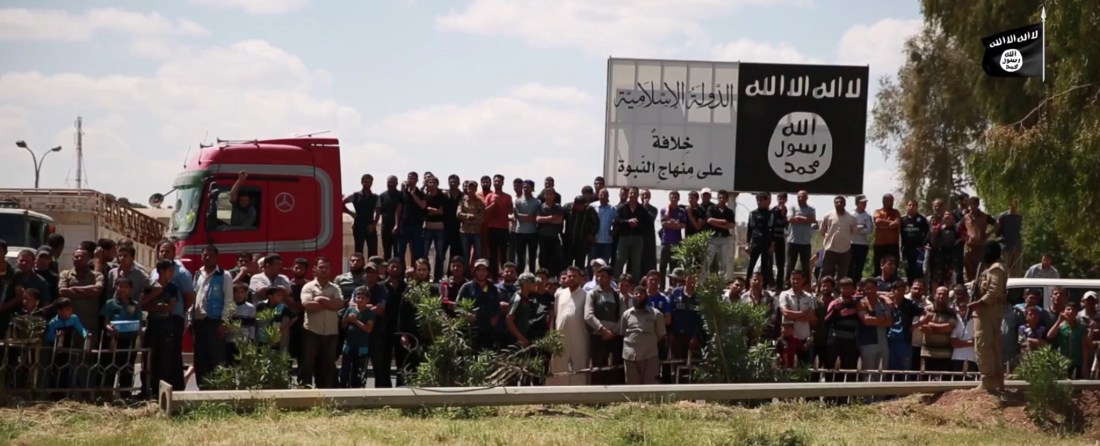
The billboard above reads: “the messenger – peace be upon him said: “between a man and shirk and disbelief  stands the abolishing of [ritual] prayer.”

As IS applies a great deal of theological documents and theories penned by generations of AQ theologians, argumentatively, AQ remains most important and has regained an active role by offshoot groups and individuals who subscribe to this monopoly of truth. The theological parameters and interpretations of Islamic sources give out a highly coherent set of ‘narratives’. While the role model of the ‘proper’ Sunni Muslim according to these principals of faith (‘aqida) and religious methodology (manhaj/minhaj) is embodied by the jihadists who claim purity and absolute proximity to god. The doctrine of Sunni extremism provides a clear identity of what it should mean to be a ‘true’ monotheistic Muslim (muwahhid) and how to profess the divine laws of God (shari’a) as based on the authoritarian interpretations and guidelines freely available on the Internet – giving answers to real life grievances in zones of conflict across diverse Islamic countries. Fighters and clerics likewise and sometimes in rotating roles relate the written ideology into actions and fierce emotional sermons conveyed by the extremist’s most powerful platform: Telegram, Twitter, Facebook, YouTube, and more; jihadi forums and dedicated websites. These role models, the corpus of texts, and most important the jihadi-affiliated and hijacked iconography most prominently represented and identifiable by the black banner with the imprinted shahada,[7] has successfully manifested within majority Sunni Islamic societies, and has even more so gained visibility within the Arab public space amid the chaos and aftermath of the so-called ‘Arab Spring’.[8] Perhaps even more so in times of upheaval and (re-) spawning of militant groups throughout the countries affected by the ‘Arab Spring’, first and foremost Syria, the emphasis of jihadist media advisors, strategists and contributors is set to emphasize their own role and importance:

“We are indeed convinced that the battlefields of the media jihad are of the most important streams of jihad and a elementary front thereof in this raging war with our enemies. Therefore, we [media workers] commit ourselves just as any jihadi brigade, working correspondingly with our brothers in the fields of war, directly encountering the enemies.”[9]

The media in principal is used on a tactical level, not only to incite and recruit individuals worldwide, but to create theological denominators and operational paradigms with policy guidelines for various jihadist groups. While “jihad” is first and foremost agreed to as being implemented by militant and violent means in general, or in short linked to “combat” (qital), the media thereof follows the rationale of propagating Islam (da’wa) and the proper religious methodology (manhaj/minhaj). This propagation thus is part of the overall objective to “establish the rightly guided caliphate” while uniting various Sunni fighting groups and individuals under this particular propagated manhaj.[10]

part 2 pic1

With the Islamic State having endured for years as the “established rightly guided caliphate”, stretching across Syria and Iraq as its core area, and the day-to-day application of the “prophetic methodology”, the legacy it already leaves behind for future jihad theaters is part of the many challenges to overcome modern-day global terrorism.

[1] Markaz al-Hayyat li’-l ‘ilam, Stories from the Land of the Living – the Story of Abu Khaled the Cambodian from Australia,

[2] Nico Prucha, Die Stimme des Dschihad “Sawt al-gihad”: al-Qa’idas erstes Online-Magazin Hamburg: Verlag Dr. Kovač, 2010

[3] See the statements by Thomas Hegghammer: https://amp.theguardian.com/world/2017/jul/23/the-culture-that-makes-a-jihadi-thomas-hegghammer-interview-poetry-militancy

[4] Ali Fisher and Nico Prucha: The Call-Up: The Roots of a Resilient and Persistent Jihadist Presence on Twitter, Global Ecco, CTX vo.4 no.3, August 2014, https://globalecco.org/nl/the-call-up-the-roots-of-a-resilient-and-persistent-jihadist-presence-on-twitter

[5] Nico Prucha: IS and the Jihadist information Highway – Projecting Influence and Religious Identity via Telegram, Perspectives on Terrorism, vol. 10, no. 6 (2016), http://www.terrorismanalysts.com/pt/index.php/pot/article/view/556

[6] For example the major IS video release “The Clanging of the Swords, part 4”, published in May 2014. The video shows IS in the early stages of conquest and consolidating territory in the al-Anbar province of Iraq. Ali Fisher, Nico Prucha, Is this the most successful release of a jihadist video ever?, Jihadica, May 2014, http://www.jihadica.com/is-this-the-most-successful-release-of-a-jihadist-video-ever/

[7] The black flag comprises a centric grey circle imprinted with (from down upwards) “Muhammad – rasul – allah”, a reference to the Islamic creed “There is no God (allah) but God and Muhammad is the messenger (rasul) of God.” The symbolic is amplified as this exact layout and wording had been the seal of the prophet (khatim al-nabawiyya) whereas the contemporary jihadists further seek to position a monopoly of truth by signing documents and by placing the flag as an expression of divine will and power. The use of the Prophetic seal, placed not only on the flag but also to sign ‘official Islamic State’ documents and rulings, is served as a nonnegotiable authority, backed by the interpretation and application of Qur’an and Sunna – speaking in the name of God and His messenger, Muhammad, furthering the belief of being in a direct lineage to divinity and expressing the entitlement of the soldiers of God (jund allah).

[8] The manifestation of pro-AQ styled jihadist groups, exercising violence or ‘soft-power’ such as restoring basic infrastructure and handing out supplies to the Sunni population is evident by the trans-national appearance of the Ansar al-Shari’a network. The Ansar al-Shari’a groups propagate openly jihadist iconography and a similar rhetoric based on the fundamental teachings of AQ. The Libyan branch based in Bengazi and Derna as well as the chapter in Tunisia had been declared by the U.S. State Department as “foreign terrorist organizations” and “global terrorist entities” following the attack on the U.S. Consulate in Benghazi, September 11, 2012. Thomas Joscelyn, State Department designates 3 Ansar al Sharia organizations, leaders, http://www.longwarjournal.org/archives/2014/01/state_department_des_2.php, January 10, 2013.

[9] Mu’assasat al-Ma’sada al-I’lamiyya / Fursan al-Balagh al-I’lam (eds.), Bayan nusrat al-ansar li-ikhwanihim al-Mujahidin al-abrar, https://shamikh1.info/vb/showthread.php?t=212520, October 10, 2013. This statement is signed by the most influential contemporary jihadi media key figures.

[10] Mu’assasat al-Ma’sada al-I’lamiyya / Fursan al-Balagh al-I’lam (eds.), Bayyan nusrat al-ansar li-ikhwanihim al-Mujahidin al-abrar, 3-5.


“Islamic State” Briefing

This is a mini-series on the “Islamic State” – from the perspective of the Arabic language materials. Often times, the Arabic language output of Sunni extremist groups is not reflected sufficiently. Analysts are quick to claim that IS is in decline, yet do not acknowledge the continuous output of Arabic materials, no matter if in writing or videos. These aspects will be briefly addressed as well in this short series entitled “Islamic State” Briefing.

Part 1: The “Islamic State” & Social Media – from Theory to Implementation

vlcsnap-2016-07-22-17h37m02s693

Sunni extremist groups such as al-Qaida (AQ) and the self-proclaimed “Islamic State” (IS) use the Internet as a communication hub to broadcast their messages. Online jihad is a phenomenon that has spread on a massive scale and at fast pace over the past sixteen years. IS in particular, puts much effort into its online operation, including maintaining and re-establishing accounts and networks on Twitter, Facebook, YouTube, and Telegram. Huge amounts of jihadist audio, video and written content can be found on these networks, mostly in Arabic.

IS has moved from Twitter to Telegram, after a mass amount of account suspensions and more effective spam filters limited the group’s appearance on Twitter. However, the move to Telegram allows IS to operate from the “dark web”[1] and orchestrate media raids and sting attacks into the “surface web”, such as Twitter and Facebook. Several hundred IS channels on Telegram ensure that the content, the videos and writings, of IS are disseminated without much interruption.

This content conveys a coherent jihadist worldview, based on theological texts penned by AQ ideologues as far back as the 1980s. The jihadists’ need for spreading theological writings has driven the development of audio-visual productions as far back as the 1980s. The purpose, back then as today, is to document who the “mujahidin” are, what they are fighting for, and who they are fighting against. It is important to stress, that no single political narrative and enemy perception exists among the militants. Rather, groups such as IS and AQ enforce a coherent theology, that makes up the foundation of what is often referred to as “ideology” in Western discourse, as outlined by Rüdiger Lohlker: “Indeed, it is crystal clear—to virtually anyone who has the linguistic capacity to grasp and the opportunity to witness what jihadists are actually saying, writing and doing, both online and offline—that religion matters.”[2]

Following 9/11, the Internet became the general platform for AQ to spread its brand of Sunni extremist theology. This theology, carved out by AQ in the 1980s, entered a new evolutionary phase in 2014 when ISIS declared a “Caliphate.”[3] This AQ offshoot then became the central organization’s primary rival, developing a massive foothold on social media sites, first Twitter[4], now Telegram, while AQ lost significant support, both online and offline.[5] AQ has the ideological seniority, projected by senior jihadist scholars (shuyukh al-jihad) such as Abu Qatada al-Filistini or Abu Muhammad al-Maqdisis, who criticized IS’ declaration of an Islamic state and disagreed with the killing of the captured Jordanian combat pilot Mu’adh al-Kasasiba. IS has proven time and again practicality, having managed to translate territorial control and alleged governance into a coherent and highly professional structured online output. IS uses AQ’s theology on two ends: (i) applied theology documented by the massive amount of videos released throughout the past three years. What AQ theorized IS puts into practice and films it, while (ii) either re-publishing AQ theological writings (lengthy books, articles, religious guidelines, legal binding documents (fatwas), military handbooks etc.) or by simply releasing a second, third edition of an AQ book.

Jihadist videos are a powerful tool – even more so when echoing from within territory that is defined as “Islamic”. Such definition is proven by IS videos by, for example, claiming to document the application of sharia law and enforcing upon society to abide to a lifestyle romanticized in salafi/ salafi-jihadist writings. The massive production and release of videos on Twitter (2013-2015) was a game changer acknowledged by a Ahrar al-Sham sympathizer on Twitter: “#dangers on the path of jihad; my knowledge on jihad is based on professional produced jihadist videos affecting the youth more than a thousand books or [religious] sermons.”[6]

Under Abu Bakr al-Baghdadi, IS[7] adopted al-Qaida’s iconography and doctrine, without being subject to its formal leadership.[8] The Internet served as a powerful tool that allowed the jihadist network to morph and spread in many directions. IS dedicates time and resources to maintain a persistent output of videos and other items – with Telegram being the primary hub to strategically dispatch new content since early 2016.

[1] The name “dark web” is often used to refer to the part of the Internet which is neither indexed nor visible by search engines such as Google and not accessible by using standard browsers such as Microsoft Edge or Apple’s Safari. Most dark websites are part of the onion network, can only be accessed using the Tor Browser which provides a high degree of anonymity to users to access websites in general. Andy Greenberg, Hacker Lexicon: What is the Dark Web? Wired, September 19, 2014,

https://www.wired.com/2014/11/hacker-lexicon-whats-dark-web/

[2] Rüdiger Lohlker, Why Theology Matters – The Case of ISIS, Strategic Review July –September 2016, http://sr-indonesia.com/in-the-journal/view/europe-s-misunderstanding-of-islam-and-isis

[3] “Statement regarding the Relationship of the Qa’idat al-Jihad group to ISIS” (in Arabic) Markaz al-Fajr li-l I’lam, https://alfidaa.info/vb/showthread.php?t=92927. Accessed February 2, 2014. Al-Qaeda Central issued this statement distancing themselves from the Islamic State of Iraq and al-Sham with the refusal of ISIS’ leader Abu Bakr al-Baghdadi to pledge allegiance (bay’a) to AQ-amir Ayman al-Zawahiri. As a consequence, the Syrian revolution against al-Assad was further divided with various ‘rebel’ factions turning on each other – including Jabhat al-Nusra, the official branch of AQ turning on ISIS and vice versa. The clash – or fitna (tribulation) – between ISIS and JN as well as other factions is the manifestation of two torrents: the claim of seniority posed by AQ and its Syrian franchise Jabhat al-Nusra versus the practicality of theIslamic State” which advanced what AQ pledged to fight for: the establishment of a Caliphate. Joas Wagemakers refers to ISIS as the Zarqawiyyun, practical military orientated individuals who seek to implement their principles of faith by brute force versus the Maqdisiyyun, adherents of Abu Muhammad al-Maqdisi who criticized the “Islamic State” for its apparent rapid move in declaring a Caliphate. For further reading: Joas Wagemakers, A Quietist Jihadi – The Ideology and Influence of Abu Muhammad al-Maqdisi, Cambridge University Press: Cambridge, New York, Melbourne, 2012.

Cole Bunzel referred to this rift as “two tendencies predominate among jihadis insofar as the Syrian war is concerned: one favoring the al-Qaeda-affiliated Jabhat al-Nusra (JN) and cooperation with all rebel groups, and another favoring ISIS and its exclusionary political designs as the reborn Islamic state, or proto-caliphate.” Cole Bunzel. “The Islamic State of Disunity: Jihadsim Divided.” Jihadica, January 30, 2014, http://www.jihadica.com/the-islamic-state-of-disunity-jihadism-divided/.

See also: Khalil Ezzeldeen and Nico Prucha. “Relationship between ISIL and local Syrian rebels break down, IHS Jane’s Islamic Affairs Analyst, Islamic World Web Watch, April 2014.

[4] Ali Fisher. “How Jihadist Networks Maintain a Persistent Presence Online.” Perspectives on Terrorism, July 2015. http://www.terrorismanalysts.com/pt/index.php/pot/article/view/426. Accesed August 1, 2015.

[5] Jabhat al-Nusra (JN), the Syrian AQ affiliate was first to use Twitter on a noticeable scale and facilitated the social media platform to disseminate propaganda videos and writings. The JN-IS divide caused JN to lose members, fighters, and media activists to the “Islamic State”. Further reading: Nico Prucha and Ali Fisher. “Tweeting for the Caliphate – Twitter as the New Frontier for Jihadist Propaganda.” CTC Sentinel (Westpoint), June 2013, http://www.ctc.usma.edu/posts/tweeting-for-the-caliphate-twitter-as-the-new-frontier-for-jihadist-propaganda

[6] Khalid Abu Anas (@khaled852111), October 10, 2015. All Arabic translations by author.

[7] At the time the “Islamic State” referred to itself as dawlat al-Islamiyya fi l-‘Iraq wa-l Sham (ISIS), then shortened its name after the declaration of the Caliphate to IS or dawlat al-khilafa.

[8] See Cole Bunzel, The Islamic State of Disobedience: al-Baghdadi Triumphant, Jihadica, October 5, 2013, http://www.jihadica.com/the-islamic-state-of-disobedience-al-baghdadis-defiance/

Jihadi Twitter Activism – Introduction

The posting with all links is available on the jihadica blog
http://www.jihadica.com/jihadi-twitter-activism-introduction/

Ali Fisher and I have recently exchanged thoughts and data regarding the increasing Jihadi use of Twitter. By taking an interdisciplinary approach of social-media analysis and cluster network assessment, we decided to start a series on Jihadica on the parts of the overall jihadi, primarily Arabic language propaganda resonating among the audiences online. We plan on delivering updates on the subject as we move along and kick-off the series with an overall introduction to the theme.

In future posts in the series, we will highlight and decipher some of the core content most often shared on Twitter, allowing conclusions to be drawn about the parts of jihadist propaganda which resonate with a wider audience (and hence shared over and over again).

Introducing the theme

The recent essay by Abu Sa‘d al-‘Amili on the state of global online jihad (discussed here) lamented a general decline in participation in jihadi online forums. Furthermore, al-‘Amili issued a “Call (nida’) to the Soldiers of the Jihadi Media” demanding that they “return to their frontiers (thughur)” elevating their status. Al-‘Amili himself is one of the high-profile clerics, a “prolific “Internet Shaykh” (Lia) on the forums, but is also quite active on twitter (@al3aamili).

Two interrelated causes identified by Abu Sa‘d al-‘Amili were the periods when forums were offline and the migration of users to social networking sites such as Twitter and Facebook. This is exacerbated by the movement of “major [jihadi] writers and analysts” (kibar al-kuttab wa-l-muhallilin) from the forums to social media platforms. This has perhaps increased the momentum of members of tier-one jihad forums to expand onto twitter while twitter as a massive communication relay has become the basis for a new generation of sympathizers, posing another intersection. Twitter is a further medium of choice to (re-) disseminate propaganda material in general and is a platform where activists, sympathizers, and actual fighters upload audiovisual and other types into the jihadi hub.

Jihadists have aggressively expanded the use of twitter, in addition to Facebook and YouTube, especially since the outbreak of violence in Syria. During 2011 members of Jihadist forums issued media-strategies and advisory to fellow members prior, as for example is stated in this posting here of the al-Ansar forum. The posting, initiated by the member Istishhadiyya is basically a very elemental guide, comprehensive and for beginners, highlighting the effective and fast communication capability. The same posting was copy-and-pasted by Shumukh member Basha’ir shortly afterwards. A handbook, compiled by Twitter user @osamh ended up on the jihadi forums to further underline the importance of Twitter as well as its difference to Facebook, where jihadists already have a strong presence.

It took a while for jihadi activism to fully unravel on Twitter, and they have maintained a cohesive as well as detailed presence on this social media platform since the Syrian conflict turned violent in 2012.

Twitter, and as such social media in general, is in the meantime an integral part of jihadists’ media endeavors on the Internet, with the majority of jihadi forums having their official account advertised for on the main pages of the forums.

The role of the media activists, or in jihadist speak the “media mujahid” has since the death of Osama bin Laden in May of 2011 been promoted, highlighted and approved. AQ related documents have made this role model prominent. The role model of the “media martyr” any “media mujahid” can be become, is backed by the call to take the fight on a greater level on al channels online issued by al-Fajr in their response of the killing of bin Laden:

“The Internet is a battlefield for jihad, a place for missionary work, a field of confronting the enemies of God. It is upon any individual to consider himself as a media-mujahid, dedicating himself, his wealth and his time for God.” (Analysis here, Arabic original here)

At first, the strategies to promote Twitter among members of jihadi forums failed to develop substantial traction, but this changed drastically during 2012. When jihadists in and outside of Syria started to use and incorporate twitter as a medium to disseminate and re-post al-Qa’ida and other propaganda material.

Twitter activism and jihadi supporters

At first Syrian non-violent activists used, and continue to use, twitter as a medium to document human rights abuse and war crimes of the Assad regime, but jihadists quickly adapted that content and the platform for their propaganda.

Social-media smart and professional jihadists adopted this treasure grove for their propaganda. By rebranding and reframing the content created by civil society activists, jihadi propaganda used these grievances to support a key jihadist self-perception; the obligation to respond by force to defend and protect the Sunnites in Syria.

Due to the effect and success of the Syrian based Jihadi groups, other jihadi groups as well as the main forums are adopting the twitter activism, advertising official forum accounts on the main pages with users within the forums using twitter hashtags (#) or references to twitter users (for example: @al_nukhba). A list of “The most important jihadi and support sites for jihad and the mujahideen on Twitter” was recently posted on the Shumukh al-Islam forum, allowing users to identify key accounts they might wish to follow.

Individual sympathizers and all those feeling inclined to contribute to the media jihad re-disseminate authoritative files of al-Qa’ida on twitter on a larger scale. Now all major jihadi media departments, part of militant networks, have their own channels on Twitter, linking to content from the jihadi forums and other social media platforms, primarily YouTube, Facebook, and pictures in general.

Twitter has turned into a primary hub for the distribution of jihadi agitprop files. These Jihadi information sharing networks using Twitter coexist, autonomously, with the classical forums. These networks carry, for example, samples of the wide range of jihadi propaganda files, in some cases placed first on Twitter, posted via mobile phones from the front lines. As a brief overview, a few samples consisting of:


  • martyrs in general and martyrdom operatives (istishhadiyyun) announced and identified by their hashtag and Twitter account;
  • calls for donations with phone numbers and social media contact information; taking care of the orphans of the martyrs among other civil elements;
  • general material of incitement, and the impact of online attained propaganda files used offline are popular and gain plenty of traction,

What are they sharing?

In addition to disseminating their own propaganda, jihadi media activists repurpose content from social movements and non-jihadi groups for their own purposes, framing the non-jihadi actions or demonstrations as part of the global militant struggle. This has created another ‘grey area’ where analysts have to carefully monitor and decipher such content. The forum administrators and media-activists also are starting to incorporate and misuse Twitter for their purposes, in coordinated attempts to virtually infiltrate legitimate social movements by using the same hash tags and a similar rhetoric to create ideological cohesion – and placing extremist views and files in that virtual sphere while claiming to fight on the ground for the sake of the people.

To analyze jihadi media networks, their sympathizers and followers we have used a combined approach focused on a unique interdisciplinary analysis of the data acquired by technical means and the subsequent and immediate analytical process of its content.

Using these methods we have asked a range of questions, how have jihadi propagandists been able to gain traction and a foothold online? How do they disseminate propaganda content to a global, multilingual audience and what resonates most with that audience? What are the networks through which their content flows and what are the different roles users play within these networks? Ultimately do the different jihadi twitter accounts reach a range of different communities, or is it a small densely interconnected echo chamber?


Jabha al-Nusra – a New Jihadi Group in Syria

Announced a couple of days ago, as an important and urgent message without providing further information, users already ‘hoped’ a new jihadi group would be announced. Their hopes are being held up high, as of today Syria ‘officially’ has a jihadi group of its own, with, as it is en vogue for years and years to come, its own media outlet. The media outlet, al-Manarah al-Bayda, something like the white lighthouse, the beacon of light/hope in contrast to Hizbullah’s al-Manarah channel, perhaps, addresses the “people of Sham” for this is a “historic event”

We shall what the video reveals, so far the content provided shows the usual rhetoric and ideology that we know of. The focus on Sham (greater Syria) is not really new, but now, since the Arab Spring is increasingly being hijacked by Islamists and fighting ones in Libya and Syria, the jihadist media is daring enough to openly claim such language from inside.

AQIM issues statement kidnapping 5 EU citizens

In a statement just published on the usual jihadist online fora, AQIM via its al-Andalus media department claims the kidnapping of 5 Europeans and the displacement inside of Mali.
Interestingly, and most threatening for the hostages, is the claim that two Frenchmen among the kidnapped are “French spies”. The statement was published today, 12.12., but is dated to 7.12.
Two operations are claimed, first “in the east of Mali, the mujahideen were able to kidnap two men of the French intelligence”. The names, in Arabic transliteration, are provided with the claim of having conducted the kidnapping on November 24, 2011.
The second operation, on November 25, 2011, in Timbuktu led to the taking of the three other EU citizens whose nationalities are not disclosed in the statement.
In a third note, AQIM denies any attempt of kidnapping foreigners in Algeria at this time.

Why Mali?

While France is the most visible enemy and threat for AQIM, the address and the demands are directed to the governments of Mali and France. The alleged French spies are just another episode in the “continued hostilities” of the respective governments “against the Muslims in the Sahel”.
French and US efforts in combating al-Qa’ida are always perceived and reproduced by the jihadist propaganda as a combined threat and a dual manifestation of the enemy.
AQIM therefore kidnapped foreigners in Mali and keeps them there to exercise pressure on r government of Mali and to punish it at the same time. Concretely, not demands, but issues of grievance prior to the kidnappings are issued:
1. The case of Muhammad al-Amin who was extradited to Mauretania;
2. The case of Abu Sa’id al-Azwadi;
3. Abu Yunus al-Mali;
4. The Mali-Mauretanian joint military operation agains the mujahideen;
5. The rebuilding of an air base inside of Mali used by France to fight the mujahideen by aerial means and measurements.

The statement concludes by the expression of grief, French participation in Afghanistan, the appeasement by Mali to the west by imprisoning and killing Muslims. “if you want the soonest release of our hostages, and to protect their lives, you must answer the legitimate demands of the mujahideen” as is addressed in particular to the government of France.

New “Fursan al-Shahada” Video about Nigeria?

In October 2010 AQIM published a video, “The Raid of al-Damus“, regarding the situation of Muslims in Algeria but also in Libya and Nigeria. The video shows revenge operations against the Algerian police and National Army soldiers, ambushed on Algeria’s remote highways. These attacks not only took place to fight the infidel regimes in the region but particularly to avenge the execution of unarmed, detained civilians by the Nigerian army. AQIM takes this as proof to further justify its deeds and military operations with sequences of Abu Yahya al-Libi and Ayman al-Zawahiri in the video.

The scenes, it seems, have been taken from Aljazeera and put in motion in the AQIM video in its propagandized surrounding. Aljazeera describes the sequence as

“Al Jazeera has obtained exclusive footage from Nigeria which shows unarmed men being shot dead. The footage was taken last year when the Nigerian government was hailing its defeat of an Islamist rebel group known as Boko Haram.” The video shows the shooting of detainees in public by the Nigerian army (2:00) which has appeared in AQIM’s video.

“Muslims annihilated in Nigeria – The Crusader army kills Muslims in cold blood”. On the bottom right the al-Andalus media logo.


Corpses of Algerian soldiers are depicted in detail. Ambushed for their service for the Crusaders as well as their participation in upholding un-Islamic regimes as well as being responsible for killing Muslims.

What has this to do with ISI and the forthcoming video “Fursan al-shahada, 8” ? While part six was all committed to self-inoculation attacks in Iraq to “support Turkistan”, this 8th edition seems to be about killing and undertaking operations in Iraq for the sake of Nigeria. Alert forum members pointed out that the picture, as it appears with the remark “soon” shows pictures of the above mentioned massacres:

Forum member “BomBer” graphically points out that these two stills are from the massacre in Nigeria. Started by a user naming himself “Mullah Abu Omar” started the thread with “Walid al-Sharqawi” responding “the brothers in charge for the publication have previously focused on various circumstances of Muslims, such as in occupied Turkistan (west China) by the communists, after the massacre [further] violating the rights of Muslims there. And in this video the focus will feature the land of the Hausa, “Nigeria”, remembering the Muslims who are being tyrannized by many different means, inciting the Muslims in “Nigeria” to carry weapons. And God knows best.”

Hijacked Islam

The self-proclaimed Islamic State of Iraq, also known as al-Qaeda in Iraq (AQI), announced today the 8th film of its notorious series of the “Fursan al-shahada“. These, mostly professionally made, movies show and depict the testimonies and attacks of those carrying out self-inoculation attacks, also termed ‘suicide’ or ‘martyrdom’ operations in Iraq. The greater meaning of the Arabic term istishhadiya is of essence, whereas the individual sacrifices his life for a greater good in order for ‘Islam’ to benefit while the Mujahid attains the status of having confessed the utmost possible for God with the claim of being rewarded accordingly in the afterlife.

The individuals read out their testimony, according to the usual habit of the jihad video genre, portray their – naturally – piety and the fear of God while moving out on “the path of God” to fulfil the divine command, a holy covenant of individual duty “to elevate the word of God”, living the lives of early Muslims solely in regard of combat and military actions – neglecting all other forms of spiritual and scholarly knowledge. This is highly effective propaganda combining the rhetoric and the wording of individual Mujahideen with the written ideology of AQ global. Here the consumers of online jihad materials find their role-models (prominently: Abu Dujana al-Khurasani) and are put in touch with elements who are in the battlefields and hotspots of jihad, who tell their tales, who have witnessed war and who express in their speech their drivers that led them to the decision of undertaking self-inoculation operations. In a previous part of “Fursan al-shahada“, the istishhadiyin operatives directed their attacks in the name of “helping Turkistan”, a region in western China where the al-Hizb al-Islami al-Turkistani went on a (Arabic) propaganda material publishing rampage after ethnic tensions rose. Since then, the “Voice of Islam”, an Arabic e-zine, is published on occasion. This edition of “Fursan al-shahada
is yet another statement by ISI to show their sympathizers that they are still in place, despite the ‘beheading’ of ISI leaders in April 2010. Further, these videos intend to deliver proof and role-models to the online crowds that the jihad for justice and truth (haqq) is not interrupted and that Iraq is as much as other theatres of jihad alive and striving for the jihadists’ understanding and definition of religion while – again – promoting martyrdom.

Anyway, with the Eid al-Adha on Tuesday, mabruk 1431!, it is certainly no coincidence, that AQ in general tries to further capitalize on public Islamic events and holidays. Usually within the forums ‘gifts’ are issued to the sympathizers and followers when Ramadan dawns. This year, Khalid al-Husaynan ‘blessed’ the online ummah with a series of speeches and sermons defining and interpreting Surahs, for example, or the “fear of hypocrisy” and the like. Punctually after the Islamic new year, AQI/ISI now announces “in order to celebrate Eid al-adha” a new movie part of the series depicting the testimony (al-wasiya) of self-inoculation operatives as well as their subsequent attacks. In some cases these operatives testimonies are filmed while sitting behind the wheel of the truck/car that will bomb them into heaven. This is attained as a deed of worship and falls into line of the jihadi school of thought as expressed by Abu Jihad al-Shami (“The Vision of the Jihaadi Movement & the Strategy for the Current Stage“):

“As it is well-known to any entry-level student of the Salafi Creed, worship is a general term that includes everything that Allaah, the Exalted, loves of actions and statements, whether apparent or concealed. Therefore, servitude is not limited to prayer, charity, fasting, and pilgrimage. Rather, included under the term ‘worship’ is Jihaad in the path of Allaah, love for the sake of Allaah and enmity for the sake of Allaah, calling to Allaah, removing oppression, judging by the Shari’ah, and ordering the good and forbidding the evil.” (p6)

In the past decade, AQ and co had been quite efficient and highly industrious within the online clouds to promote, expand and thus hijack specific religious, social and particularly historic settings, seeking to manifest proof of their actions as based on the alleged righteous, true and pious creed and subsequently being by their worldly actions closer to God than other individuals. The gaps have been filled and nowadays known faces such as al-Awlaqi shock the western media when all the sudden his sermons and speeches can be retrieved in English on YouTube, facebook, Twitter and other websites in various languages. This is certainly another dangerous and alerting fact but the missionary spreading of AQ’s definitions, wordings and notions have infected the internet for a very long time and new materials (videos and writings) appear almost daily, covering more and more niches and providing an in-depth appeal by letting the Mujahideen speak, who undertake such istishhadiya operations against foreign and/or domestic enemies, attaining both: fame online as well as the shahada (according the jihadist creed). An assessment of legitimizing the two severe istishhadiya operations in 2007 in Algiers can be obtained here.

By such “surprises” and “gifts”, the global torrents of jihad further attempt to hijack public parts of Islam, expressing a violent conduct as proper and rightful celebration of public holidays while adherents of this specific ideology speak out to provide personal justifications bound to an universal understanding of fighting Satan, the apostates, the disbelievers and what have you. Gifts and “glad tidings” are disseminated via the forums and instantaneously spread online.

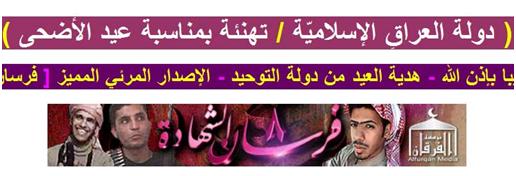
“Soon, with the permission of God – 8”

Khalid al-Husaynan’s sermon on the 9th surah of the Quran – a gift during the holy month of Ramadan (published in August 2010).